Why an IGF-1 Result May Be Rechecked
“Let us repeat the test” can leave you wondering what changed. The most useful clarification is what the repeat is meant to resolve. A question about whether a finding persists differs from a question about two laboratory methods or a possible measurement problem.
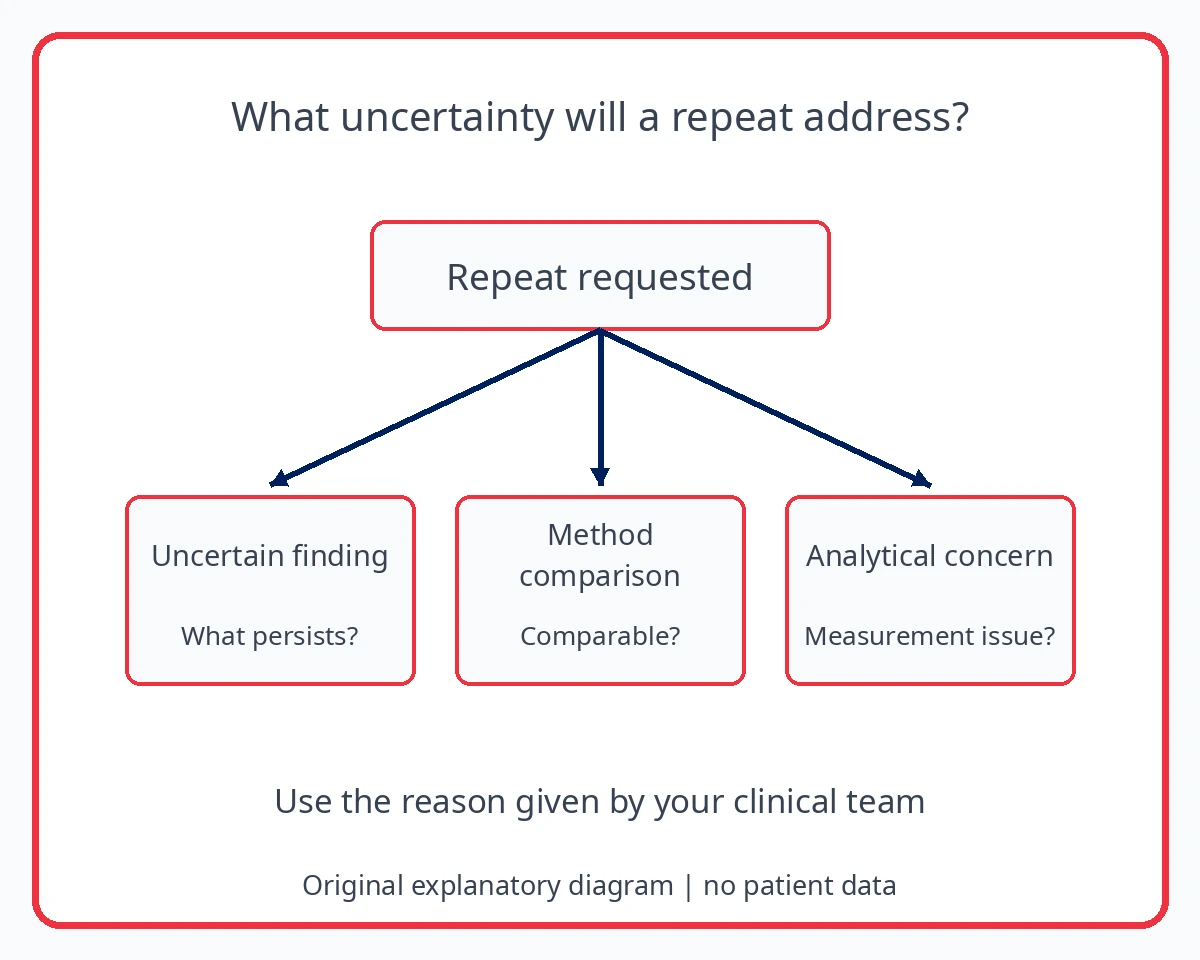
Identify the uncertainty being addressed
MedlinePlus explains that uncertain or potentially inaccurate results may lead to further testing. Translate “repeat the test” into a more specific question: is the clinician checking whether a finding persists, resolving conflicting information or clarifying the original result? These are different purposes. Record the reason given by your team rather than inferring it from the appointment date or the fact that another sample is requested. [1]
Different uncertainties need different explanations
Chanson’s assay comparison shows that changing the measurement method can affect how results are compared. A separate issue is whether something interfered with the measurement. Mayo’s clinical information, for example, notes the possibility of inaccurately reduced IGF-1 measurements with biotin-containing supplements for the assay discussed there. This is a specific analytical caution, not proof that a supplement affected your report.
Tell the service which medicines and supplements you actually take and let it supply the instructions for your test. Do not assume another laboratory’s instructions apply. A repeat request by itself does not establish laboratory error, worsening disease or a need to stop a product. [2] [3]
A repeat request with its reason preserved
Fictional records illustrate an administrative conversation, not a recommended retesting interval or preparation protocol.
| Item | Illustrative entry | Current status |
|---|---|---|
| Reason stated by team | Clarify interpretation after reports from two laboratories | Recorded from the review discussion |
| Service and test | Named endocrine service; repeat IGF-1 requested | Appointment details to follow from that service |
| Method question | Will this use the same method as either earlier result? | Question sent; reply pending |
| Preparation | Current medicine/supplement list supplied; one instruction unclear | Service asked to clarify before attendance |
| Result review | Endocrine team to explain the result with both earlier reports | Confirm the communication route with the team |
Ask whether the original question has been answered
The fictional patient writes “repeat requested to clarify the earlier comparison” at the top of the new report. At follow-up, the question becomes: “Can these results now be interpreted together, and what remains uncertain?”
If the team gives a different reason for the repeat, preserve that reason instead. An appointment date or a second blood sample cannot tell you the purpose on its own.
For the method question behind a repeat, use Comparing IGF-1 Results From Different Laboratories
Give the retest card a purpose and a return route
Keep the team’s explanation with the appointment information. Record the named service, the test requested, any unresolved preparation question and who will discuss the result. The card should distinguish confirmed arrangements from messages still awaiting a reply.
After the report arrives, attach it to the earlier result and the stated reason for repeating it. This makes the follow-up conversation more useful: you can ask whether the original uncertainty was resolved, rather than simply asking whether the new number looks better.
To prepare a medicine and supplement history for the team, see Making a Medication List for a Pituitary Hormone Review
The team determines preparation and timing
A repeat test is not proof of laboratory error. This guide does not decide the interval between tests or advise medicine, supplement or fasting changes.
Sources and reading context
- MedlinePlus understanding laboratory results — Reference intervals, units and contextual interpretation; no personal diagnosis
- Chanson and colleagues 2016 IGF-I reference values for six immunoassays — Primary assay-comparison evidence; not a conversion rule
- Mayo Clinic Laboratories IGF-1 serum — Physiology and historical interpretation example only. Page currently says Not Orderable due to assay issues. Do not cite as available service or copy preparation instructions or universal ranges.