Why a Random Growth Hormone Blood Result Needs Context
A single GH value captures one moment in a signal that changes over time. The same person can be sampled near a pulse or between pulses. That timing is one reason a clinician may need a different kind of evidence before explaining what a result means.
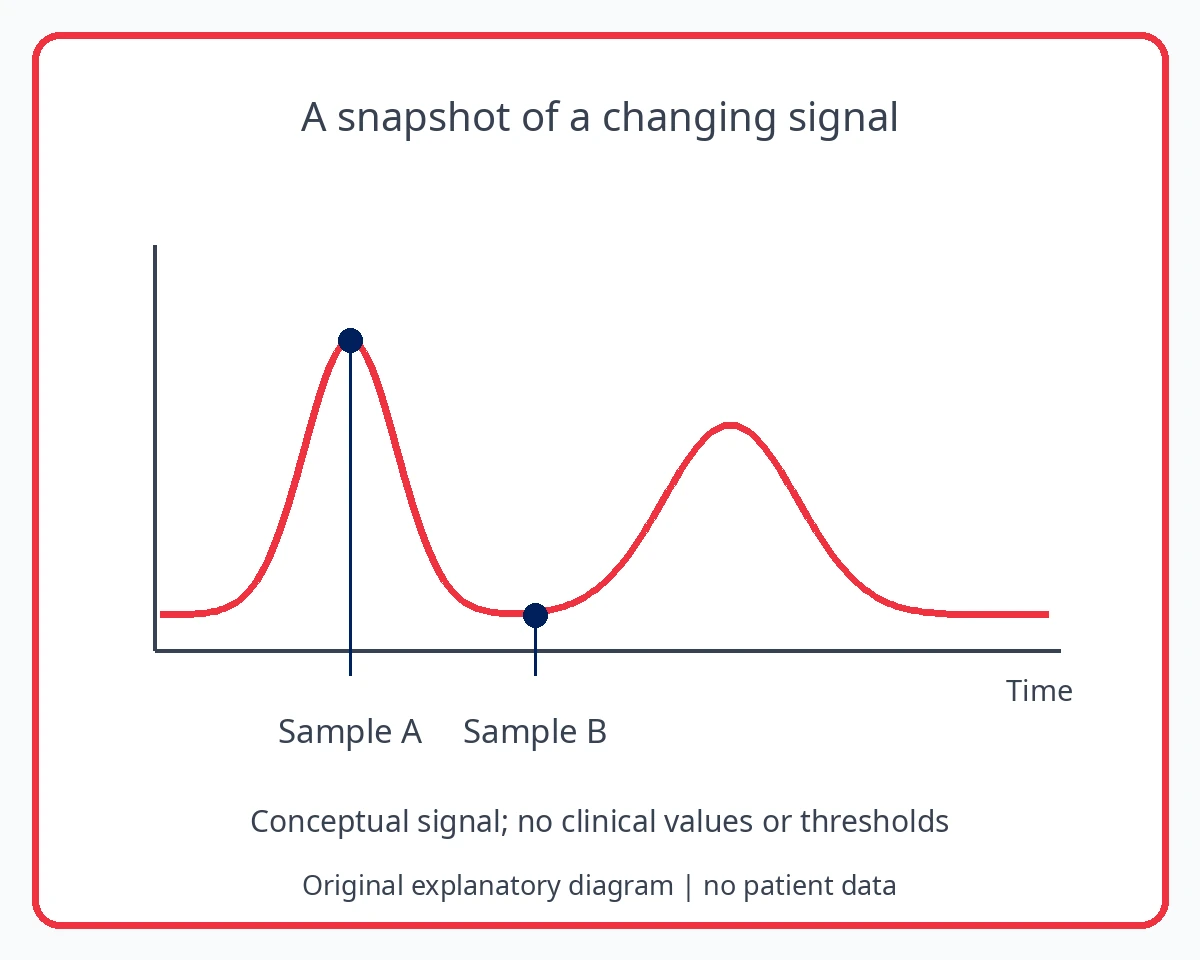
A snapshot can miss the pattern
GH is released in pulses rather than staying at one steady concentration. MedlinePlus describes the limitation of a single GH blood measurement. A sample taken between pulses and one taken during a pulse can capture different moments. The conceptual curve in this article illustrates that timing problem only: it is not a normal curve, a patient result or a timetable for choosing your own sampling time. [1] [3]
Why IGF-1 supplies different information
MedlinePlus describes GH levels as changing through the day, while IGF-1 is more stable. That helps explain why an assessment may include IGF-1 rather than rely on an isolated random GH value. The two names should remain separate in your records: they are related hormones, not alternative labels for one test.
More stable does not mean unchanged in every circumstance or sufficient for every diagnostic question. The reason for the assessment, the person’s history and the specific test all matter. When reading the report, first identify which measurement you actually have. [2]
Records that should keep different labels
These are fictional filing examples. No hormone values, test timing protocol or diagnostic thresholds are supplied.
| Record received | Accurate label in the notes | What stays with it |
|---|---|---|
| One GH value from a standalone sample | Random GH result; specimen time retained | Original report and reason requested |
| One IGF-1 report | IGF-1 concentration, with unit and interval | Its own laboratory and reference information |
| A starting sample from a named dynamic test | Baseline within that complete test series | Full report, subsequent sample labels and clinic explanation |
| A screenshot of one later sample | One part of the series, not the final interpretation | Link back to the complete series |
The curve explains the question, not your result
On the conceptual diagram, sample A is near a pulse and sample B is between pulses. They capture different heights on the same changing signal. The drawing has no clinical scale or recommended sampling time; it simply shows why a snapshot cannot describe the whole pattern.
For a real result, a useful opening is: “Is this a random measurement or part of a planned response test, and what evidence should be read with it?” That keeps the discussion focused on the actual record rather than turning one value into a daily hormone score.
To read the related IGF-1 report without mixing it with GH, use Reading an IGF-1 Blood Test Report: A Patient Worksheet
Keep a sample label attached to its full testing context
A dynamic test follows a planned stimulus or suppression procedure and examines a response using a defined series. Its starting sample is part of that series. MedlinePlus describes the different purposes of stimulation and suppression testing; the clinic selects and interprets the assessment in context.
If a portal displays the samples on separate cards, keep their original labels, sequence and complete report together. Selecting the highest or lowest card removes the testing context. The filing table shows how to file the records without inventing a sampling schedule or choosing a result as the answer. [1]
If your clinician has arranged an adult GH stimulation test, prepare for the visit with Planning a Growth Hormone Stimulation Test Visit With Your Clinic
For the different questions answered by hormone function tests and imaging, read HGHThai’s guide to endocrine investigation
Use the service’s instructions for the actual assessment
No sampling schedule, test protocol or diagnostic threshold is provided. Follow the instructions from the service performing your particular test.
Sources and reading context
- MedlinePlus growth hormone tests — Use pulsatile secretion and purpose only; inconsistent stimulation/suppression wording in results excluded
- MedlinePlus IGF-1 test — Test-purpose and contextual interpretation; not a diagnosis from one result
- Mayo Clinic Laboratories IGF-1 serum — Physiology and historical interpretation example only. Page currently says Not Orderable due to assay issues. Do not cite as available service or copy preparation instructions or universal ranges.