Reading an IGF-1 Blood Test Report: A Patient Worksheet
The bold number on an IGF-1 report attracts attention first. Yet the small print beside it—unit, reference interval and specimen date—does much of the work. Reading one complete line before looking up its meaning gives you a better starting point for the conversation with your clinician.
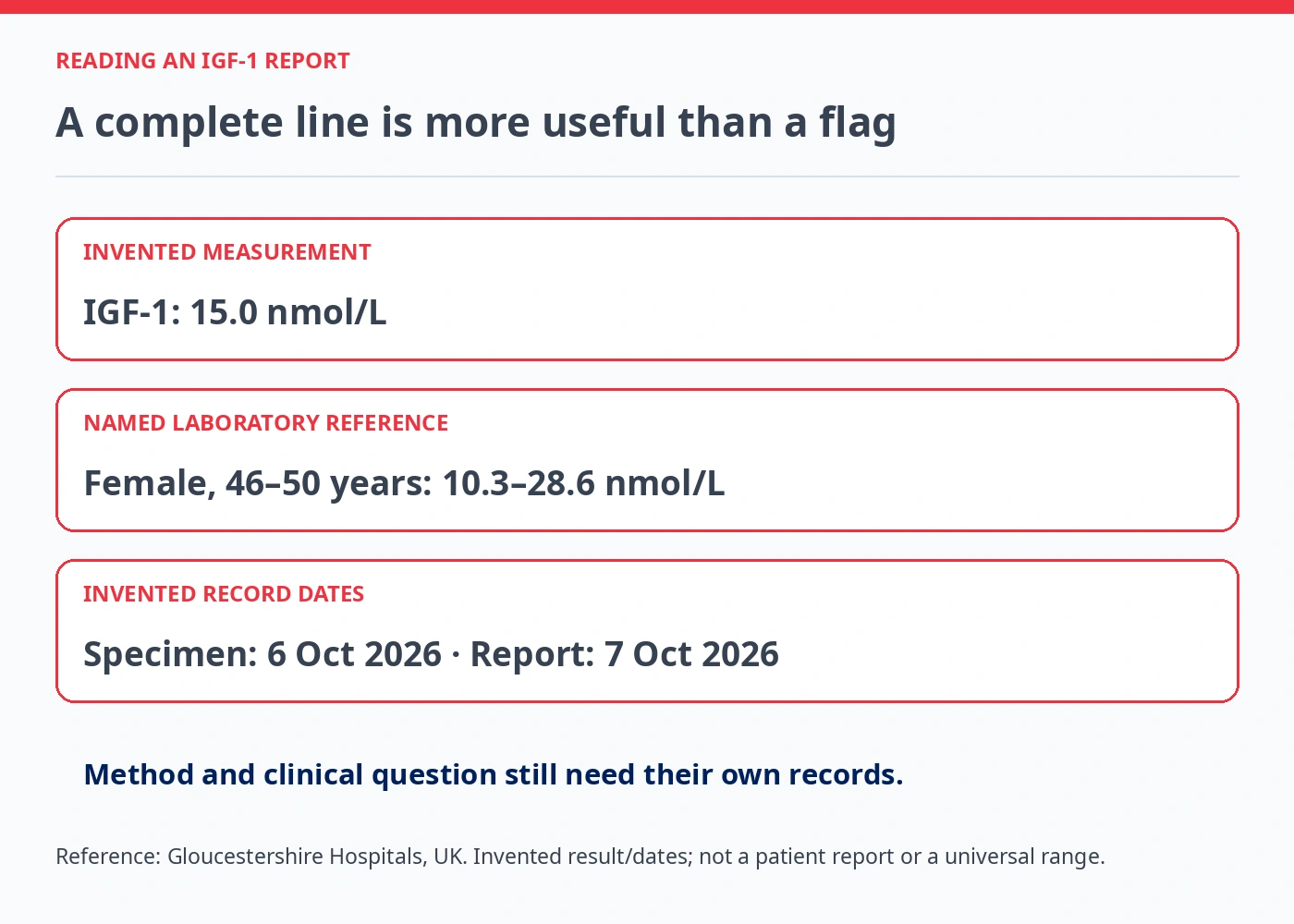
Identify the measurement before interpreting the flag
Find the analyte name first: an IGF-1 result and a GH result are not interchangeable entries. Copy the value exactly with its unit and the interval printed alongside it. MedlinePlus explains that reference intervals depend on the laboratory and the group used for comparison. A flag marks a relationship to that interval; it is not a diagnosis written in shorthand. A screenshot that cuts off the unit or interval removes information needed to read the number. [1]
If the analyte line says GH rather than IGF-1, read a random GH result in context before applying the worksheet to that different measurement.
Separate the reference group from your clinical question
IGF-1 changes with age, so a range copied from a different age group can be misleading. The question behind an ordered test also matters: investigating possible deficiency is different from following a known condition. MedlinePlus describes IGF-1 testing as part of an assessment that may involve other information and tests. Record the reason your clinician gave for testing, using their wording. Do not replace it with an explanation suggested by a search result. [2]
If the report also gives an SDS or Z-score, distinguish an IGF-1 concentration from an SDS before copying it into the same column as the measured value.
A completed reading example
The published interval is source-specific. The imaginary result and dates are included only to demonstrate report fields.
| Field | Example entry | What the annotation says |
|---|---|---|
| Analyte and result | IGF-1: 15.0 nmol/L — invented result | Measurement; keep the unit attached |
| Reference information | Female, age group 46–50: 10.3–28.6 nmol/L | Published Gloucestershire Hospitals interval, not a universal range |
| Specimen / report dates | 6 October / 7 October 2026 — invented dates | Collection and issue are different events |
| Method | Not stated in this teaching example | Ask the laboratory if needed for comparison |
| Clinical question | Why was IGF-1 requested in this assessment? | Question for the team; not supplied by the number |
What can be read from that line?
In the teaching example, 15.0 lies between the two displayed interval limits. That describes the numerical relationship. It does not tell us whether the result answers the clinical question or excludes a disorder. The next useful step is to bring the complete report and the reason for testing to the clinician.
If all you receive is a cropped message saying “IGF-1 normal”, retrieve the full document. Your annotated copy should make the source easier to read, rather than turn a short portal label into a fuller conclusion than the report supports. [1] [3]
When a unit or copied heading is unclear, continue with Reading Units and Reference Intervals on Hormone Test Reports
For background on the relationship between GH and IGF-1, read HGHThai’s growth-axis explanation
Annotate a copy in three passes
First, mark the measurement: test name, value and full unit. Second, mark the comparison: the printed reference interval and the age or sex category used. Third, add the question: why the clinician ordered the test and what you still need explained. Keep this annotation separate from the original PDF so your notes cannot be mistaken for the laboratory’s wording.
The example uses one published interval from Gloucestershire Hospitals, a UK laboratory, to show where comparison information belongs. Its listed female interval for ages 46–50 is 10.3–28.6 nmol/L. The result and dates in this example are invented; this is a reading exercise, not a patient report or a range for other laboratories. [3]
To preserve the original report and later amendments, use Organizing Laboratory Results for a Pituitary Appointment
If the report is flagged high, prepare questions about a high IGF-1 flag while keeping the measured result separate from any imaging discussion.
Use the full report in the clinical discussion
This guide explains report structure. It does not decide whether a result establishes or excludes a hormone disorder, or whether treatment should change.
Sources and reading context
- MedlinePlus understanding laboratory results — Reference intervals, units and contextual interpretation; no personal diagnosis
- MedlinePlus IGF-1 test — Test-purpose and contextual interpretation; not a diagnosis from one result
- Gloucestershire Hospitals IGF1 laboratory information — One named laboratory uses nmol/L and notes nutrition context; not a universal interval