A Low IGF-1 Result: What Context Your Clinician May Need
Seeing “low” beside IGF-1 can make several recent experiences suddenly seem connected. It is reasonable to bring those concerns to the appointment. A useful set of notes keeps the laboratory finding, the symptoms and the possible explanations separate long enough for the clinician to assess them.
Start with the report’s comparison
A number that looks small beside an online example may still belong to a different age group, unit or laboratory method. MedlinePlus explains why the printed reference interval must remain attached to the result. Copy the flag exactly and avoid replacing it with a stronger statement such as “proven deficiency.” This keeps the distinction between an observed result and a clinical conclusion clear. [2]
Low does not identify one explanation
MedlinePlus describes low IGF-1 in adults as potentially related to GH deficiency or other circumstances, including age and other health conditions. Gloucestershire Hospitals’ laboratory information also notes malnutrition as a context for low IGF-1. These are reasons to review the whole situation, not a checklist from which to choose a diagnosis. A recent change in eating or health is useful history even when its relationship to the result is unknown. [1] [3]
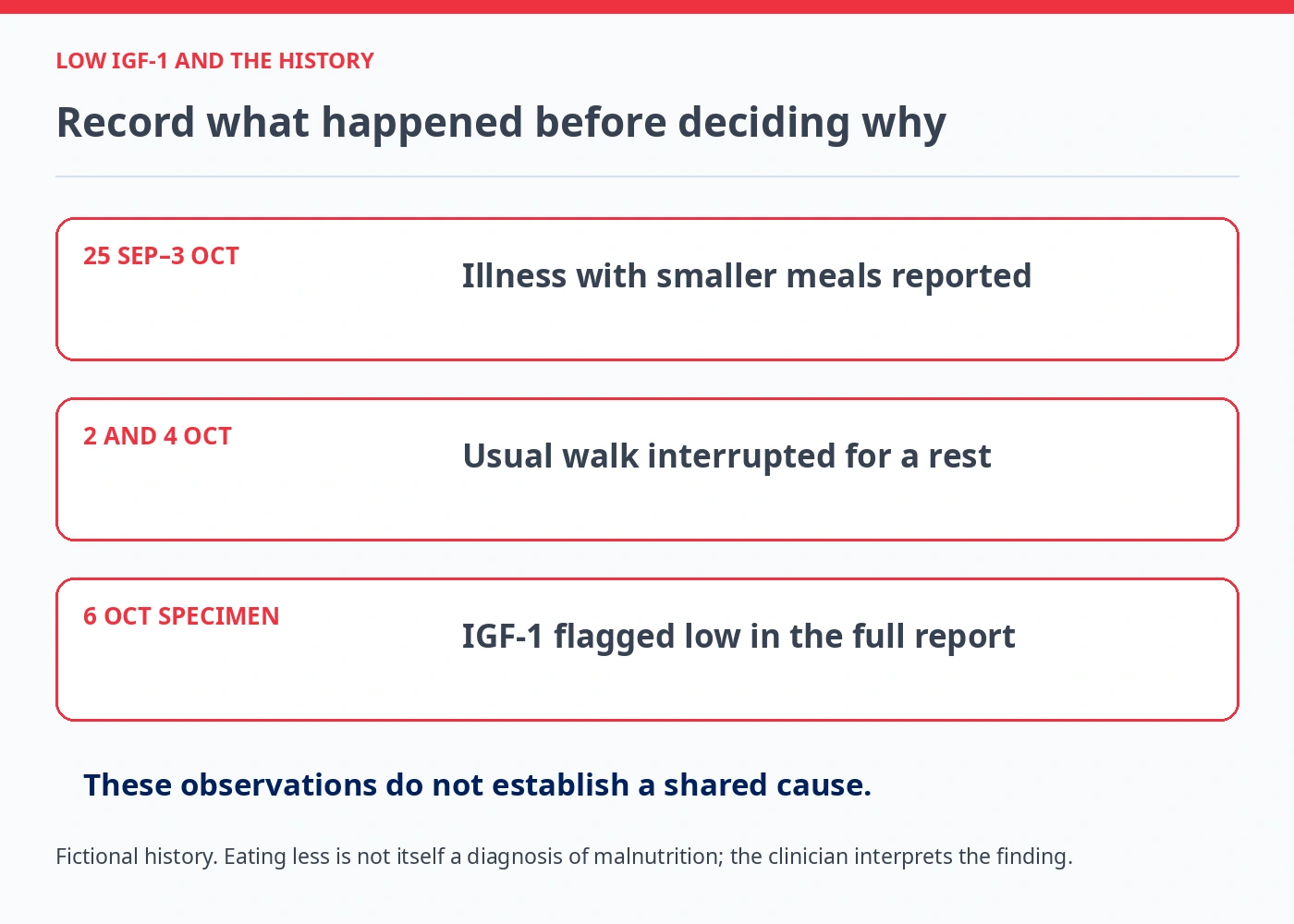
For those recent changes, place nutrition and illness changes on a timeline around the specimen date without turning their timing into a cause.
What is known, and what remains a question
This fictional history contains no diagnostic threshold or treatment recommendation. The full original report would accompany it.
| Category | Illustrative note | Status |
|---|---|---|
| Laboratory finding | Specimen 6 October; report flagged IGF-1 low against its printed interval | Finding recorded; original value, unit and interval retained |
| Daily effect | Stopped the usual walk to rest on 2 and 4 October | Observed events; cause unknown |
| Appetite history | Smaller meals during an illness from 25 September to 3 October | Reported history; nutritional status not assessed here |
| Current question | Do these events affect how the result is interpreted? | For the clinical discussion |
| Follow-up question | What information is still needed, and who will review it? | To agree with the team |
A clearer opening for the appointment
“My report was flagged low. I had to rest during two walks, and I ate less during an illness before the sample. I do not know whether those things are related.” This opening presents the concern without making a diagnosis on the clinician’s behalf.
If the team identifies an explanation or asks for further information, add that response as a dated note. Keep the initial observations intact so the record shows what you noticed and what was concluded later.
For help identifying the report fields before the visit, use Reading an IGF-1 Blood Test Report: A Patient Worksheet
For how an IGF-1 result fits into a broader deficiency assessment, see HGHThai’s growth hormone deficiency guide
Write a short history that can be checked
Anchor the notes to the specimen date, then describe what changed in daily life and when. Use observations you can stand behind: a usual walk shortened by tiredness, meals left unfinished, or the dates of an illness. If the duration or amount is uncertain, say so rather than filling the gap from memory.
The invented note in this example contains a reported low flag, tiredness and reduced appetite. It does not establish that the appetite change represents malnutrition or that IGF-1 explains the tiredness. Those are questions for assessment. Keeping them separate gives the clinician more useful evidence than a single sentence with an assumed cause.
To describe how tiredness affected a real activity, use A Symptom Diary for an Endocrine Appointment: What to Record
Interpret the finding with the clinical team
An abnormal result does not establish a need for GH treatment. Do not use supplements, a diet change or medication changes to chase a number without an agreed clinical plan.
Sources and reading context
- MedlinePlus IGF-1 test — Test-purpose and contextual interpretation; not a diagnosis from one result
- MedlinePlus understanding laboratory results — Reference intervals, units and contextual interpretation; no personal diagnosis
- Gloucestershire Hospitals IGF1 laboratory information — One named laboratory uses nmol/L and notes nutrition context; not a universal interval