Nutrition, Illness, and IGF-1: Context to Bring to an Appointment
A change in appetite or an illness near the time of an IGF-1 sample can feel too ordinary to mention. It may still be useful history. A short timeline helps the clinician judge that context while keeping the laboratory result open to proper interpretation.
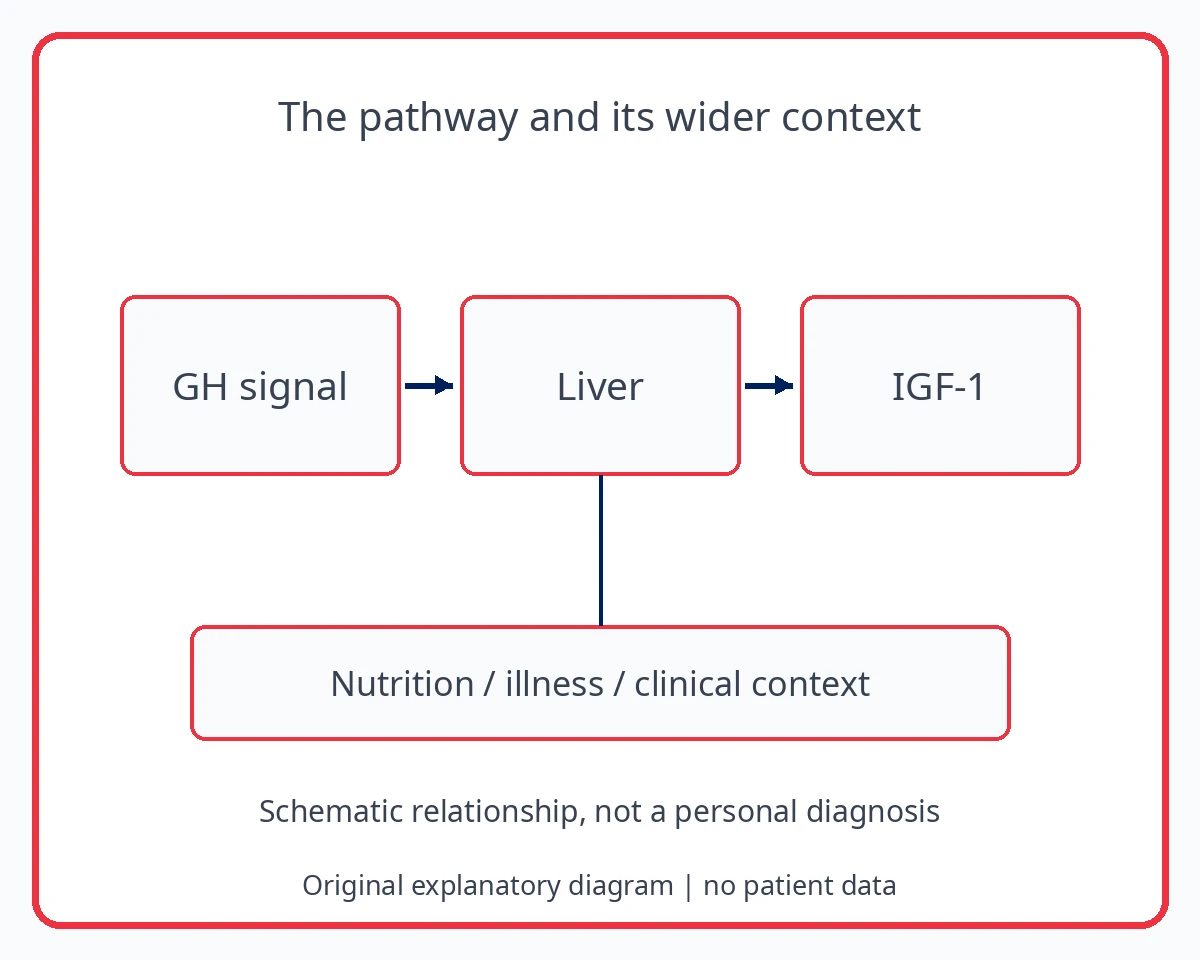
Why wider health belongs beside the hormone pathway
Gloucestershire Hospitals describes the liver as the main source of circulating IGF-1, under the control of pituitary GH. The simplified pathway in the illustration shows that relationship. It does not include every tissue or regulatory influence, and it cannot explain an individual result on its own.
The same laboratory notes that IGF-1 can be low in malnutrition. That makes an actual change in eating or health relevant history to discuss; it does not make reduced appetite a diagnosis of malnutrition. Describe what happened and let the clinical assessment determine its significance. [1]
Make the timeline specific enough to discuss
Use the specimen date as an anchor. Around it, note the dates of an illness, how eating changed, whether usual activities changed, and any care received. General laboratory guidance emphasises interpreting a result in context, so bring the original report with these observations rather than trying to explain the number from the timeline alone.
Include what happened afterwards. If appetite returned, say when; if it remained reduced, record that instead. An uncertain date can remain approximate. The goal is a usable account of your experience, not a perfectly filled calendar. [2]
A timeline around the specimen date
Invented dates and experiences demonstrate how to preserve context without claiming a cause.
| When | Observation in the example | What is still uncertain |
|---|---|---|
| 25 September–3 October | Illness with reduced appetite; meals often left unfinished | Exact intake not measured |
| 6 October | IGF-1 specimen collected; original report saved | Meaning of the result requires review |
| 8–12 October | Appetite improving, but not described as fully back to usual | No nutritional assessment recorded |
| At the appointment | Medicine/supplement list and history of care brought separately | Ask which details affect interpretation |
Say what changed, rather than what it must have caused
“I ate less during an illness before the sample, and by 8–12 October my appetite was improving. Could that affect how you interpret the report?” This gives the clinician a sequence and a question.
“Poor nutrition caused the result” would add both a nutritional diagnosis and a causal conclusion. The first account is more useful because its uncertainty is visible and the team can explore it.
If the report is flagged low, bring this context to the questions in A Low IGF-1 Result: What Context Your Clinician May Need
Keep the question open without dismissing the result
The fictional record in this example supports the statement that reduced appetite occurred before sampling and had partly improved by the later note. It does not show how much energy or protein the person consumed, establish nutritional status, or measure the effect on IGF-1.
Ask which parts of the history matter to the assessment and what should happen next. A possible contextual explanation should not be used to dismiss a finding that still needs review, or to start a diet or supplement plan simply to raise the number.
To add specific changes in daily activity to the history, use A Symptom Diary for an Endocrine Appointment: What to Record
Context supports assessment; it does not replace it
No diet, supplement or hormone treatment is recommended. Nutritional assessment and laboratory interpretation are individual clinical tasks, not exercises in raising a number.
Sources and reading context
- Gloucestershire Hospitals IGF1 laboratory information — One named laboratory uses nmol/L and notes nutrition context; not a universal interval
- MedlinePlus understanding laboratory results — Reference intervals, units and contextual interpretation; no personal diagnosis