Reading Units and Reference Intervals on Hormone Test Reports
A note saying “IGF-1 150” has preserved a number and lost part of the measurement. The unit, reference information and source report are what make that number readable. This becomes especially easy to miss when copying between a laboratory PDF, a French-language portal and an English summary.
Preserve the whole measurement expression
A unit states what a measurement represents. In hormone reports, the numerator and denominator both matter: a mass-per-volume expression is not written the same way as an amount-of-substance expression. Copy capital letters, prefixes and the denominator exactly from the report. MedlinePlus lists differing laboratory units and explains that intervals also vary. A shortened note should not remove the information needed to identify what was measured. [1]
Recognise the unit without treating it as a conversion shortcut
The French assay-comparison study by Chanson and colleagues reports IGF-I concentrations in ng/mL, while Gloucestershire Hospitals publishes IGF-1 reference information in nmol/L. The first is a mass-per-volume expression; the second is an amount-of-substance-per-volume expression. These examples show why the unit must travel with the result.
Changing the unit is a separate task from establishing whether two laboratory methods are comparable. Even a numerically correct conversion would not make their reference systems interchangeable. This guide therefore keeps the original expression and asks the laboratory to clarify a comparison when needed. [2] [3]
Copying errors to catch
The numbers and short entries below are invented transcription exercises. They are not reference ranges or patient results.
| Copied note | Information lost or changed | Accurate next action |
|---|---|---|
| IGF-1 150 | Unit and reference information omitted | Retrieve the complete original line before comparing |
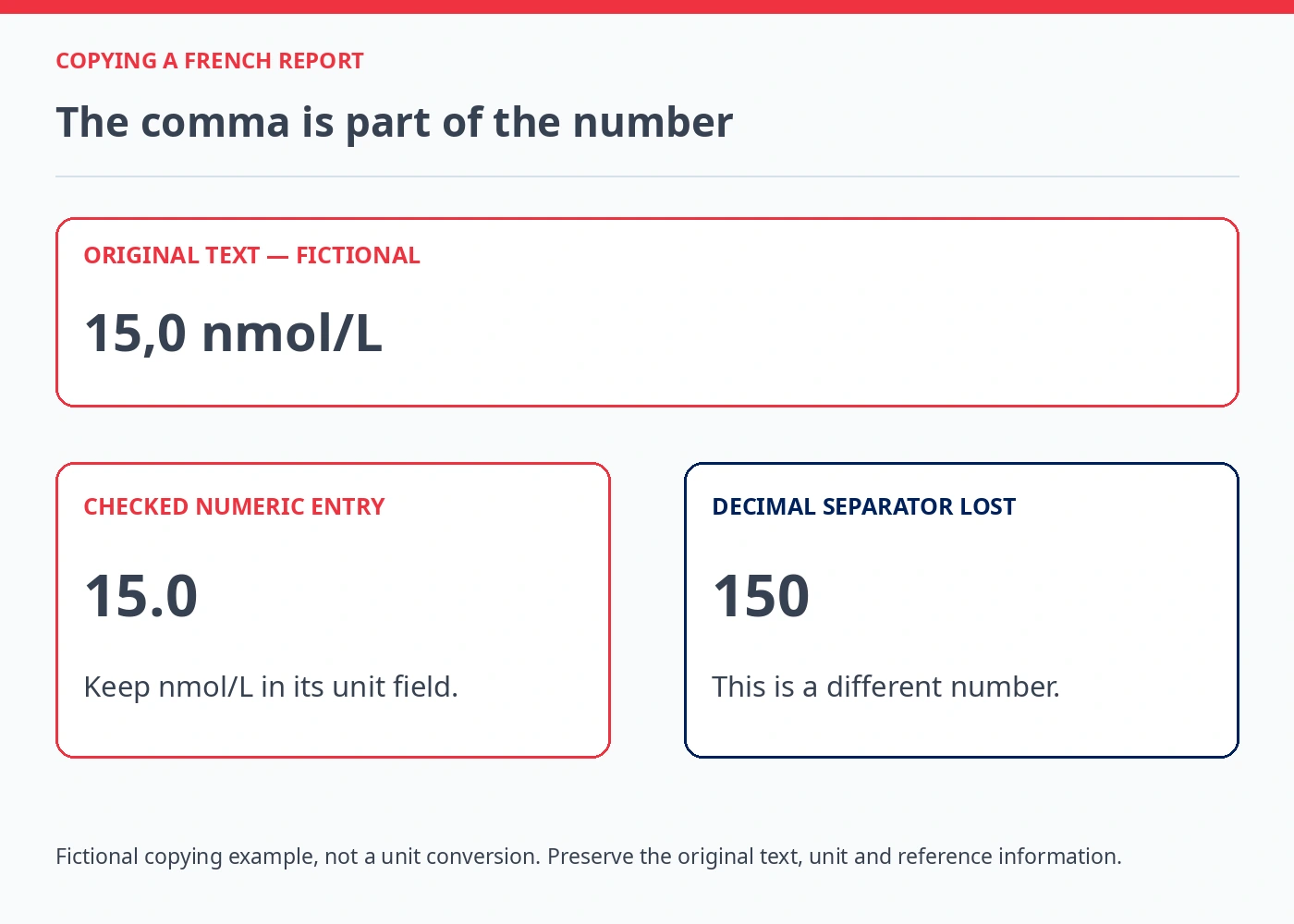
| 15,0 nmol/L entered as 150 | Decimal comma removed, changing the number tenfold | Preserve raw text; enter 15.0 only after confirming the decimal format |
| 20 nmol/L placed under a column headed ng/mL | The column assigns the wrong unit | Keep 20 with nmol/L; do not relabel it as a conversion |
| A reference interval pasted into the result field | Comparison information mistaken for the measurement | Check the original headings and restore separate fields |
Keep the raw line beside the tidy spreadsheet
An English summary may use a decimal point while the original report uses a comma. In the teaching example, keep a column containing the raw text “15,0 nmol/L” and a checked numerical entry of 15.0 with nmol/L in its own field. The original report remains linked beside them.
If the layout or punctuation is ambiguous, leave the numerical entry unresolved and ask the laboratory. A clean spreadsheet is useful only when it preserves the meaning of what was reported.
For a complete worked report-reading example, use Reading an IGF-1 Blood Test Report: A Patient Worksheet
Check the number, punctuation and headings after copying
Compare the copied text against the original, including decimal punctuation. In the invented transcription example, “15,0 nmol/L” is being used with a decimal comma. Its numerical meaning is 15.0 nmol/L, not 150 nmol/L. Keep the original wording alongside any reformatted value and check that a spreadsheet has not silently changed it.
On a French report, “valeurs de référence” refers to the comparison information, not the patient’s measured value. Assurance Maladie explains that these reference values vary with the assay method, sex and age. Translate the heading in your notes if helpful, but retain the actual laboratory information rather than replacing it with a range from a general guide. [4]
To preserve the source documents behind your summary, see Organizing Laboratory Results for a Pituitary Appointment
The original report remains the source
This article is a transcription and reading guide, not a conversion tool. It does not provide universal hormone reference intervals or decide whether results are clinically comparable.
Sources and reading context
- MedlinePlus understanding laboratory results — Reference intervals, units and contextual interpretation; no personal diagnosis
- Chanson and colleagues 2016 IGF-I reference values for six immunoassays — Primary assay-comparison evidence; not a conversion rule
- Gloucestershire Hospitals IGF1 laboratory information — One named laboratory uses nmol/L and notes nutrition context; not a universal interval
- Assurance Maladie: Comment lire les résultats d’une prise de sang? — French-language guidance on reading reference values and preserving laboratory context; not an IGF-1 diagnostic rule.